What Kite Sizes do I Need in Brazil?
Planning a kitesurf trip to Brazil and wondering what kite size you need? The answer depends on your weight, the region you're visiting and the expected wind conditions. This guide helps you choose the right kite sizes for different destinations across Brazil.
Thanks to Brazil’s consistent wind conditions—especially along the Northeast coast—it’s one of the best places in the world for reliable sessions almost every day. That said, bringing the right kite size will make all the difference in how much you enjoy your time on the water.
Recommended Kite Sizes
Kite Sizes for Northeast Brazil (Cumbuco, Jericoacoara, Barra Grande, etc.)
This region is famous for strong and steady trade winds from July to January, with average wind speeds ranging between 16 and 25 knots, often peaking in the afternoon. It is important to know that, in that part of the country, the more west you travel, the stronger the wind gets. For instance, if you are at Cumbuco (Ceará) and the wind speed is ranging between 15 and 18 knots, you can expect it will be stronger heading west to Paracuru, and even stronger in Preá.
Recommended kite sizes:
- For lighter riders (under 60 kg): 6m² to 9m²
- For average-weight riders (60–80 kg): 7m² to 10m²
- For heavier riders (80+ kg): 9m² to 12m²
It’s common to ride with smaller kites here, especially between September and November and between Ilha do Guajiru and Atins. If you are planning to stay more at the east – between Paracuru and Barra do Cunhaú, for instance, consider bringing kites of the largest sizes in the above-mentioned spectrums.
Kite Sizes for Rio de Janeiro & South Brazil (Santa Catarina, Porto Alegre, etc.)
Wind conditions in the Southeast and South regions are more variable, and the season isn’t as consistent as in the Northeast. Expect winds between 12 and 20 knots, depending on the spot and time of year.
Recommended kite sizes:
- For lighter riders: 8m² to 11m²
- For average riders: 9m² to 12m²
- For heavier riders: 11m² to 14m²
In these regions, it’s a good idea to bring a larger kite, or even a lightwind kite (13m²–15m²) if you're visiting outside the peak season.
Some Quick Tips
If you're bringing only two kites, a good combo for most conditions in Brazil would be:
- 7m² and 10m² for lighter to average-weight riders.
- 9m² and 12m² for heavier riders or for more versatile use across different regions.
Lucas, from hooked, travels very often along the Northeast. He weighs 75 kg and 1,80 m tall and usually carries an 11m² and an 8m² kite. This combination is enough for him to kite most of the time during the season.
How to Calculate Your Ideal Kite Size
If you want to be precise, there is a formula to help you to get to the most appropriate size according to the wind speed, which is:
(Riders Weight in kg / Wind Speed in knots) X 2.2 = Recommended Kite Size
Example: If Lucas, who weighs 75 kg, is in Cumbuco and the wind is now at about 16 knots, he would make the following calculation:
(75 kg / 16) X 2.2 = 10,3125
Rounding down, that means that the ideal kite for a kitesurfer with 75 kg at 16 knots would be a 10m². Naturally, other approximated sizes such as 11 or 9 would also work in the same conditions and the type of kite also has an influence.
Quick Reference Table for Choosing the Right Kite Size
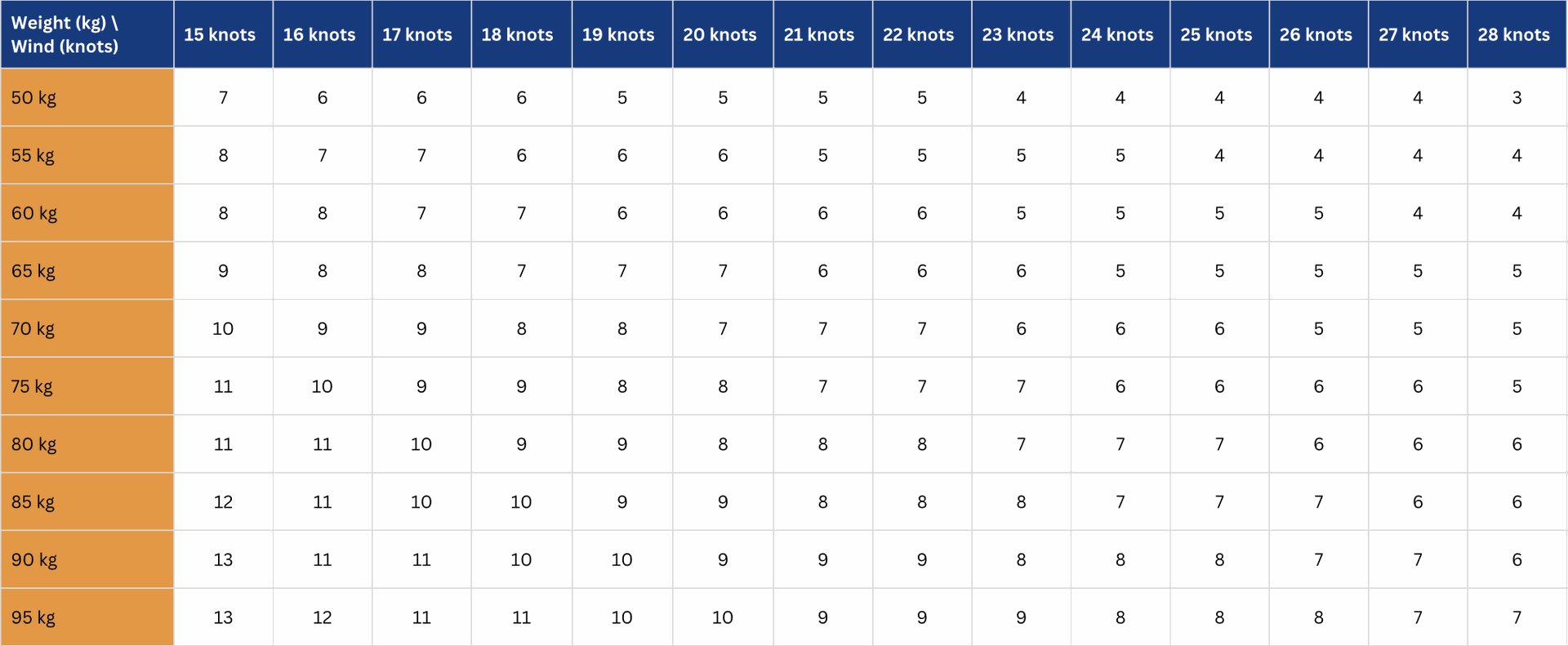
Rider weight plays an important role when choosing the right kite size. Lighter riders generally use smaller kites, while heavier riders need larger kites to generate enough power in the same wind conditions.
Don’t forget to consider the size of your board too—larger boards can help in lighter wind conditions.
Need Kitesurf Equipment Rentals in Brazil?
Don’t want to travel with your entire quiver? Many kite spots in Brazil have gear rental and repair services available. We can help you book quality equipment in advance so you travel light and ride comfortably.
Need Help Choosing the Right Kite Size?
Tell us your weight, skill level and travel dates, and we'll recommend the best kite setup for your trip and destination.